Most Expats Never Get Past “Shukran”. And honestly, that’s understandable. Arabic has a reputation for being one of the harder languages for English speakers to pick up, and between work, settling in, and navigating daily life in the UAE, language learning tends to get pushed to the bottom of the list.
But here’s the thing: you don’t need to be fluent for Arabic to meaningfully improve your experience of living here. Even a basic working knowledge changes how you interact with colleagues, neighbors, and the city around you. The question is just where to start, because starting in the wrong place is one of the most common reasons people quit early.
This is the conversation most beginner resources skip, and it matters a lot. Arabic isn’t a single uniform language. There’s Modern Standard Arabic (MSA), which is the formal, written version used in news broadcasts, official documents, and education across the Arab world, and then there are spoken dialects, which vary by region and are what people actually use in daily conversation.
In the UAE specifically, you’ll mostly encounter Gulf Arabic (Khaleeji) in everyday settings, though the expat population is so diverse that you’ll also hear Egyptian, Levantine, and other dialects frequently. Meanwhile, signage, formal correspondence, and government communication tend to use MSA.
If you want to read Arabic, navigate formal contexts, or build a foundation that works across multiple Arab countries, MSA is the stronger starting point.
If you want to hold conversations, build rapport at work, or feel more at home in daily life in the UAE, Gulf Arabic gets you there faster. Many learners in the region end up combining both over time, but trying to do both simultaneously from day one tends to lead nowhere. Pick a lane first.
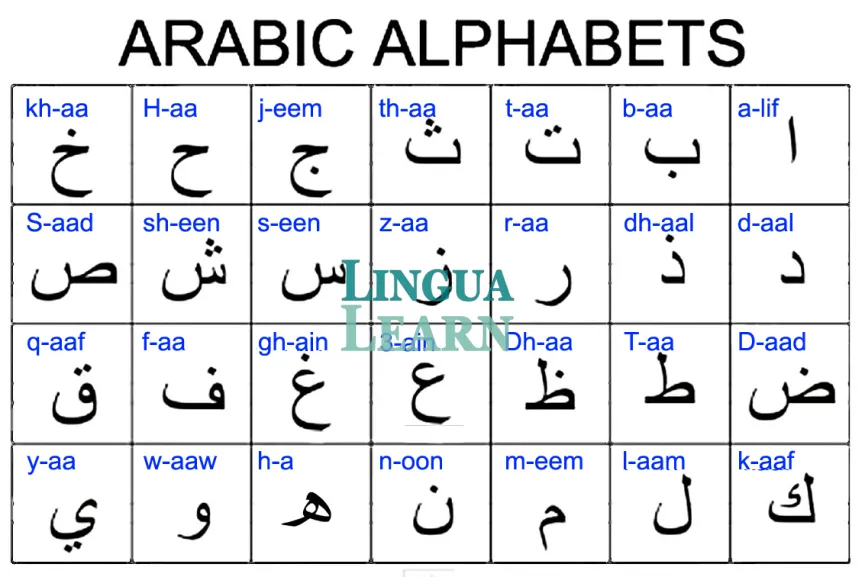
Arabic script looks unfamiliar to most beginners, and a lot of people try to sidestep it by relying on transliterations, romanized versions of Arabic words. This is a trap!
Transliteration systems are inconsistent, and they prevent you from reading any real Arabic text, including the signs and menus around you every day. Spending two to three weeks on the alphabet is time well invested. Most learners can read basic Arabic within a month of consistent practice.
2. Build vocabulary around your daily life
Generic word lists are fine, but vocabulary sticks better when it’s rooted in your actual environment. If you work in hospitality, real estate, or finance, the Arabic words you encounter in those contexts will lodge in your memory faster than vocabulary from a textbook designed for a different kind of learner.
Label things around your home or office in Arabic. Use the language you’re building in the places you already are.
3. Prioritize speaking early, even badly
Arabic learners often spend months studying before they attempt to speak. This is partly because the script and sounds feel so different from English, and partly because there’s a fear of getting it wrong. But speaking early, even haltingly, is what converts passive knowledge into something usable.
The UAE is genuinely forgiving in this regard; locals tend to appreciate any effort from expats to engage with the language, even imperfect attempts.
4. Listen actively, not just passively
Putting on Arabic radio or TV in the background has some value, but it’s limited. What actually builds comprehension is active listening where you’re focused, you’re catching words you recognize, and you’re tracking patterns.
Arabic-language YouTube channels, short news clips, and even children’s shows are useful at the beginner stage because they tend to use clearer, slower speech.
5. Find a structured course, not just an app
Apps like Duolingo are fine for picking up isolated words and staying consistent, but they’re not built to take you to functional fluency. Arabic in particular requires structured instruction because of the grammar, the verb conjugation system, and the root-pattern logic that underlies most vocabulary. A proper course with a qualified teacher closes gaps that self-study tends to leave open for years.
6. Use the city as your classroom
This is an advantage expats in the UAE actually have. Arabic is everywhere around you, on road signs, in shops, in conversations at the supermarket. If you’re actively learning, these are not just background noise; they’re free practice material. Try reading signage on your commute.
Pick up a phrase from a conversation you overhear and look it up later. Living in a country where the language is present in daily life is an asset, but only if you’re paying attention.
Conversational fluency in Gulf Arabic, the kind where you can navigate daily interactions confidently, is achievable within twelve to eighteen months of consistent, structured study.
Reading and writing in MSA takes longer, often eighteen to twenty-four months, depending on how much time you’re putting in each week.
The main variable isn’t talent. It’s consistency. Thirty minutes a day will outperform three hours on Sunday every time.
There’s something worth noting here: despite the fact that English is widely spoken and most expats can get through their entire working day without Arabic, the city rewards those who make the effort.
Speaking even a few words of Gulf Arabic in the right context builds a different kind of connection with Emirati colleagues and neighbors, one that signals genuine interest rather than just professional necessity.
If you’re ready to move past “shukran” and build something real, Lingua Learn’s Arabic courses are designed for adult learners at beginner level, with instructors who understand the specific context of learning Arabic as an expat in the UAE. Take our assessment test to find the right starting point for where you are now.

 EN
EN  AR
AR