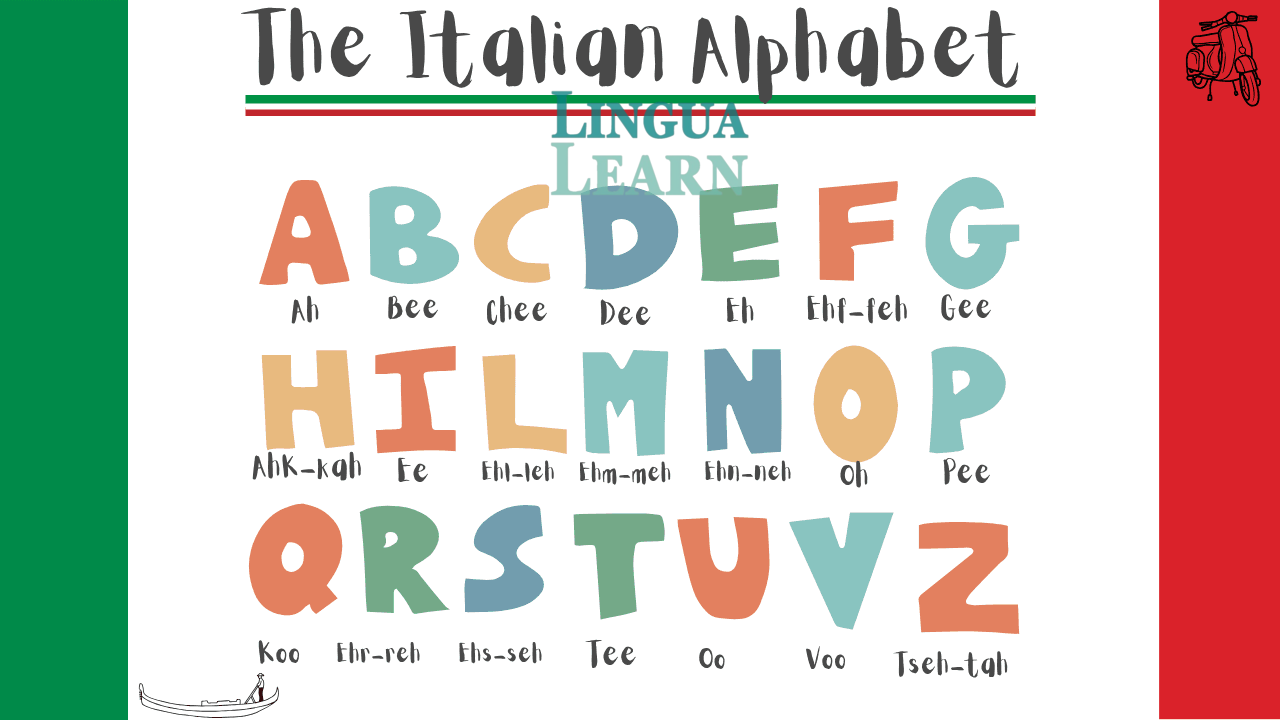
Italian is a phonetic language. That means words are pronounced the way they’re written, almost without exception. Once you learn the sounds that each letter (and a few letter combinations) make, you can read Italian out loud correctly without having memorized the word before. Compare that to English, where “though,” “thought,” and “through” all look similar but sound completely different, and you start to appreciate what Italian learners are working with.
The Italian alphabet has 21 letters. The five you won’t find in the native Italian alphabet are J, K, W, X, and Y, though they show up in borrowed foreign words. Everything else uses the same Latin script as English, which means there’s no new writing system to tackle.
Italian has five vowels: A, E, I, O, and U. Unlike English vowels, which shift sound depending on surrounding letters and stress patterns, Italian vowels are pure and stable. Each one sounds the same regardless of where it sits in a word.
A few things worth knowing:
When two vowels sit next to each other in Italian, both are pronounced separately. They don’t blend into a new sound the way they often do in English.
Most Italian consonants behave the same way they do in English. The ones that trip people up tend to be the ones that change sound depending on what follows them.
These two are the biggest sources of confusion for beginners.
C is pronounced like the English “k” when followed by A, O, or U (so “cane” sounds like “kah-neh”). But when followed by E or I, it shifts to a “ch” sound, like in “church.” So “cena” (dinner) is pronounced “cheh-nah,” not “seh-nah.”
G follows the same pattern. Before A, O, or U, it makes a hard “g” sound as in “go.” Before E or I, it softens to a “j” sound, like in “gelato,” which is pronounced exactly as English speakers say it.
GL before the vowel I makes a sound similar to the “lli” in the English word “million.” The Italian word “famiglia” (family) uses this sound.
GN sounds like the “ny” in “canyon.” So “gnocchi” is pronounced “nyok-kee,” which explains why it’s so commonly mispronounced by English speakers seeing it for the first time.
The letter H is silent in Italian. Always. “Ho” (I have) is pronounced simply “oh.”
This is the one sound that genuinely takes practice. The Italian R is a rolled or tapped sound made at the front of the mouth, not the back like the English R. It doesn’t come naturally to most English speakers, and it’s also one of the most common sounds in the language, so there’s no avoiding it. The good news is it improves quickly with regular practice and listening.
Italian doubles consonants frequently, and it actually changes the meaning of a word. “Pala” (shovel) and “palla” (ball) are different words distinguished only by that doubled L. The doubled consonant gets a slightly longer, more emphatic sound, not a completely different one, but enough to matter.
Getting pronunciation right early in your Italian learning journey pays off more than people expect. Because Italian is phonetic, good pronunciation habits mean you can decode new words correctly on sight, rather than having to look up how each one is said.
It also makes listening comprehension click faster, since you start recognizing written words in spoken form much more naturally.
If you’re ready to start building that foundation properly, Lingua Learn’s Italian courses are designed for adult learners at all levels, with qualified instructors who make sure pronunciation gets the attention it deserves from the very first lesson.

 EN
EN  AR
AR